
The Authenticity Paradox
Why in a Media Mosaic World Democrats Struggle to Sound Human

There is a rule in communications worth engraving on every strategist’s eyelids. The medium is never neutral. It is not just the vessel for a message. It shapes the meaning behind it. Every platform comes with rules for what gets rewarded, what gets penalized, and what gets ignored.
For decades, political language was written for the stage. The podium, the op-ed page, the evening newscast. The job was to sound smart, sound right, and above all sound consistent. Updates descended from on high. That worked because the channels were few, the audiences were predictable, and there was no obvious competing authority.
Yeah, that world is gone.

Linear broadcast is over. We live inside a mosaic of feeds, chats, and micro-formats, a nonlinear, attention-scarce ecosystem of podcasts, posts, memes, reels, and livestreams. In many homes, someone scrolls for half an hour before saying good morning to another person. In this world, persuasion is earned by presence. Trust is built through resonance. Message control reads like a tell that you are either hiding something or not listening. A generation raised online has an instinct for tone, subtext, and performance. They read the semiotics of social in real time.
Democrats are still optimizing for the wrong game. A press-release offense in a TikTok league. They spend their energy on fully footnoted moral coherence while the culture is demanding emotional fluency. This is not an argument to abandon facts. It is an argument to remember that people, not facts alone, make meaning. People today are looking for what feels real, reactive, and human.
The medium has changed. The message, too often, has not.

From Broadcast to Mosaic: The Communications Shift
Before social media, political communication resembled plumbing. Build the pipe, send the message, assume it arrives intact. A few trusted channels, a few trusted messengers, and a public that still believed trust was the point. The system ran on push. Press release to story to audience to impact. Linear, sequenced, controlled.
Now the message splinters. It is memed, stitched, remixed, and reframed by a teenager on Discord before a communications director finishes a caption. The path to persuasion winds through creators, group chats, fan edits, subreddits, and short videos that vanish tomorrow. The channels changed, but more importantly the logic of influence changed.
Today fluency outranks consistency. By fluency I mean the ability to read a room, adapt format and tone, and still deliver the same values. Many establishment communicators were trained for sameness. They treat credibility as a function of credentials. Online, credibility is a function of context.
“Democrats want to be right; Republicans want to be loud. The internet rewards loud.”
Being right does not move people if it does not make them feel something. And online, loud is a feeling.
Scripted statements that sound like they were A-B tested by committee scan as elitist and distant. We have confuse record-correction with persuasion and wonder how we end up culturally inaudible. Until we grapple with that, we’re just correcting the record as it burns.
Authenticity Has Been Redefined (and Newsom Might Be the First to Get It)
If authenticity is no longer sameness, what is it. In the mosaic era, authenticity means coherence across context. You are allowed to sound different on TikTok than in a Senate hearing. You should. No one wants a press conference on TikTok, and no one wants a meme at a crisis briefing. What matters is that the underlying values do not change. The tone does. The format does. The human voice adjusts. We all code switch to one extent or another. We are different with our boss than we are with our best friend. No one would say that you’re being inauthentic or lying. You’re being legible to the room.
Democrats often mistake adaptation for pandering. They cling to sameness out of fear of flip-flopping or fear of falling out of the elected-leader persona. That rigidity does not reassure. It alienates. In this media environment, sameness looks fake. Flexibility reads as real.
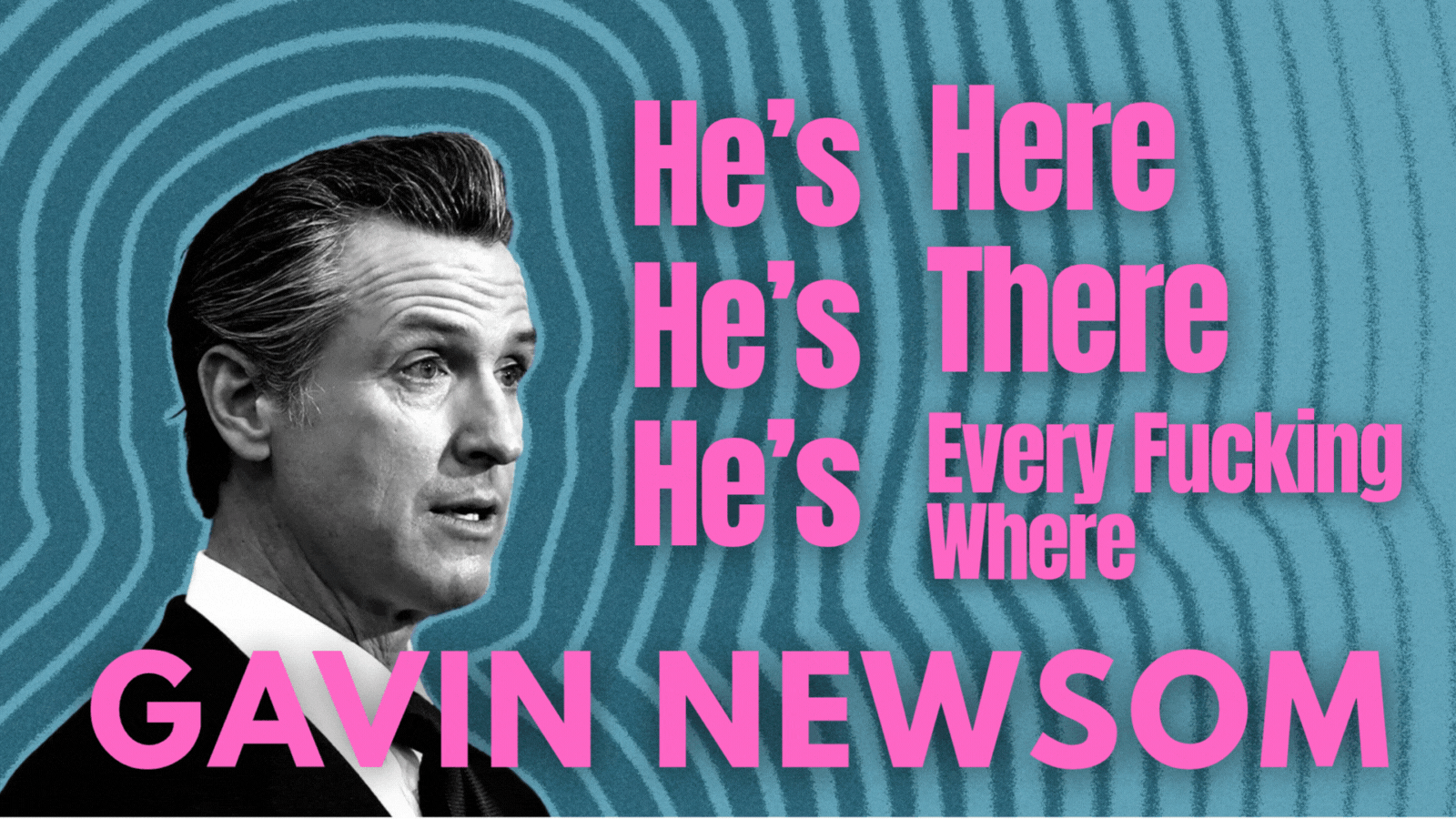
Which is what makes Gavin Newsom lately such a fascinating case study, not because he’s perfect at this, but because he’s trying.
Gov. Gavin Newsom’s Platform Fluency
Gavin Newsom is not the model only because there is no single model. He is, however, a useful case study because he is trying to communicate like a contemporary rather than a legacy politician, which is kind of is. Shaking that is work, and he’s putting in the hours.
On his podcast, he speaks in long-form, values-driven conversation. It’s a strategic move, and probably a vanity one. Podcasts are where complexity is allowed to breathe, and trust is built through tone, not talking points. Underestimate them at your own peril.
On Twitter/X, he has launched an entire account designed to be parody of Trump and his sycophants. It’s not message tested. It’s rapid response. He has smart young talented people running it. He doesn’t sound like a consultant. He sounds like someone who lives here too. It may not persuade new people, but it gets attention. And attention shifts the algorithm to push out content that IS more persuasive those viewers way.
In traditional press settings, He’s still the Governer of the world’s 5th largest economy. He’s running one of the largest states in the nation and know show to keep it professional, polished and deliver information confidently and with strength.
“Newsom isn’t the first Democrat to understand that authenticity today isn’t about having one voice everywhere, but he is the 1st to own it across multiple spaces and show up fluently
What matters is not that he is everywhere. It is that he sounds different in each place without losing the thread. That is narrative integrity. Beliefs stay constant. Delivery shifts. Reach expands. The risk is real. Clips travel without context. Agreeableness can drift toward glibness. That is the price of playing the modern game. You trade some safety for reach and, if you are disciplined, the reach pays off.
Fluency Over Flawlessness
This is not a lesson in policy. It is a call for campaigns and civic groups to fund and train for platform fluency. Flawless, uniform messaging is no longer how you win. You need to show up across formats, understand tone, speak with people rather than at them, and never lose the core of who you are.
You can test messages until the ballots are counted. To earn trust, you also need to meet people where they are with a presence that feels relatable and reliable. Give them information. Give them some levity. Give them reasons to hope. Persuasion starts when people believe you are in it with them.
Show up. Not as products of a careful machine searching for the least offensive phrase. Show up as people. That is how we lead and how we’ll win.